
China’s Shilajit Extract market deserves careful comparison, not a quick ranking. A polished website can show neat jars and mountain imagery. It cannot prove the contents match the label. Buyers should examine supplier experience, raw-material traceability, manufacturing controls, and recent batch-specific test reports.
Shilajit researcher Dr. Shibnath Ghosal’s published work on the material points to a practical sourcing principle: verify identity and composition rather than relying on broad marketing claims. That principle matters when comparing Chinese suppliers. Ask for the botanical or material identification method, contaminant testing, and clear specifications for fulvic and humic compounds. Check whether reports identify the tested batch and laboratory. A certificate without those details leaves questions.
Details matter. A responsive supplier should explain how it handles incoming material, processing, storage, and quality checks. It should also answer questions without promising medical results. Claims of purity need evidence. So do claims about origin.
Not every gap is a warning sign. Some suppliers may need time to retrieve a report, and paperwork can be imperfect. Still, unexplained inconsistencies deserve follow-up. This guide will compare potential suppliers by the evidence they make available, their communication, and the clarity of their product information. The aim is not to declare a winner from a sales page. It is to help buyers ask better questions before placing an order.
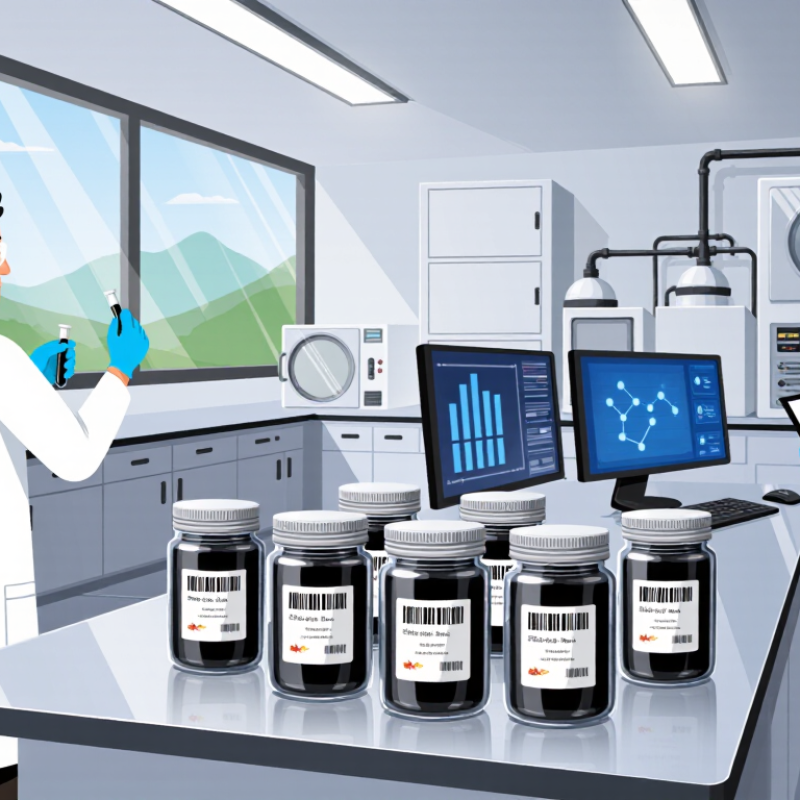
Shilajit extract begins as a dark, resin-like material collected from rock crevices in high-altitude regions. It is not a single plant extract. A 2012 review in Phytotherapy Research describes shilajit as a complex mixture containing fulvic acids, other humic substances, and dibenzo-α-pyrones. Its composition can vary with geological origin and collection conditions. That variation matters.
Production usually starts with sorting raw material to remove visible grit and stones. Processors then dissolve it in water, filter out insoluble particles, and concentrate the liquid into resin or powder. Temperature and filtration choices affect the final material, so “extract” does not guarantee one uniform composition. Careful suppliers test identity, microbial quality, and contaminants such as heavy metals, then document batch results. Ask for those records. A certificate should identify the tested batch, not merely describe a general product. The weak point is that processing details and test methods are not always comparable across suppliers. More disclosure would help buyers assess quality.
China’s shilajit extract supply chain is best understood as a sequence of checks, not a single factory process. Raw material may enter through specialist importers, then move to processors for sorting, extraction, concentration, and drying. Each handoff should preserve the origin, batch number, and test records. Small details matter. A sealed sample and a matching lot code can prevent confusion when shipments are blended or repacked.
Trade data needs careful reading. UN Comtrade places many botanical saps and extracts in the broad HS 1302 category; it does not isolate shilajit as a separate product. So broad export totals cannot prove China’s shilajit output or supplier rankings. That gap is easy to overlook. Buyers should request batch-specific certificates of analysis and review identity, moisture, heavy-metal, and microbial results against agreed specifications. China’s National Bureau of Statistics tracks manufacturing through broader industrial classifications, which also do not identify shilajit alone. Supplier audits can therefore help fill the reporting gap: check whether incoming-material records connect clearly to the finished extract. I would not treat a polished certificate as proof by itself; document review and a retained sample are still useful.
Companies supplying shilajit extract in China generally fall into three groups. Extract processors handle purification, concentration, and drying, then sell bulk powder or resin to ingredient buyers. Some work with imported raw material, so a Chinese processing address does not necessarily mean the shilajit was harvested in China. Their product sheets should identify the form, batch specifications, and test methods used.
Ingredient distributors source material from several processors and offer smaller or mixed-volume orders. They can be practical for buyers comparing samples, but traceability may vary. Contract manufacturers are another option. They may incorporate supplied extract into capsules or powders and coordinate packaging and production checks. The categories can overlap. That can make supplier descriptions confusing.
Ask for a recent certificate of analysis tied to the actual batch, not just a generic specification sheet. Check identity, moisture, and relevant contaminant results, and confirm how any fulvic-acid figure was measured. Paperwork alone is not proof. A sample should match the written specification, and the supplier should explain storage conditions and batch coding clearly. Even careful checks have limits; methods and reporting formats can differ between suppliers.
| Supplier type | Typical role in the supply chain | Products commonly offered | What buyers should verify | Best suited for |
|---|---|---|---|---|
| Botanical and natural-ingredient extract manufacturers | Process raw material into a standardized ingredient, often supplying other manufacturers rather than consumers. | Bulk extract powders, custom specifications, and sometimes resin or liquid formats. | Manufacturing-site details, process description, batch-specific certificate of analysis, identity testing, and contaminant results. | Supplement and functional-product manufacturers needing bulk ingredients. |
| Importers and ingredient distributors | Source material from producing regions or overseas processors and resell it to domestic business customers. | Packaged bulk powder, resin, or other supplier-specified formats. | Country and region of origin, traceability records, import documentation, storage conditions, and the identity of the actual processor. | Buyers seeking local procurement, smaller orders, or consolidated ingredient sourcing. |
| Contract manufacturers and OEM/ODM suppliers | Use supplied or sourced ingredients to manufacture finished products according to a buyer's formulation and packaging requirements. | Capsules, tablets, powders, or other finished formats, subject to the facility's capabilities and applicable rules. | Facility qualifications, ingredient sourcing, formulation records, finished-product testing, labeling review, and export documentation where relevant. | Brands and distributors looking for private-label or custom-manufactured products. |
| Trading companies and export agents | Arrange supplier introductions, quotations, logistics, or export coordination; they may not manufacture or physically process the material. | Products sourced from partner manufacturers or distributors, with specifications that can vary by source. | The legal seller, actual manufacturer, product origin, sample-to-batch consistency, and who is responsible for testing and documentation. | Buyers who need sourcing or export support and can independently qualify the underlying manufacturer. |
| Finished-product supplement companies | Sell consumer-ready products and may source extract from third-party manufacturers or ingredient suppliers. | Retail products such as capsules, powders, or resin, depending on the seller's product range. | Full ingredient list, batch testing, traceability, applicable product registration or filing, and claims permitted in the sales market. | Retail buyers or businesses seeking ready-to-sell products rather than raw extract. |
| Buyer note: These are supplier categories, not a verified ranking of individual companies. Shilajit is a naturally occurring mineral-organic material associated with high-mountain regions; a supplier's location in China does not by itself establish the material's origin. Confirm origin, composition, batch-specific testing, and applicable regulatory status before purchase. Test specifications and available documentation vary by supplier and product. | ||||
When comparing Chinese shilajit extract suppliers, ask for records tied to the exact production lot, not a generic sample certificate. A useful certificate of analysis should identify the material and report test methods and results for heavy metals, microbial contaminants, and key composition markers. Confirm that an independent laboratory performed the tests, and check its ISO/IEC 17025 accreditation. The Council for Responsible Nutrition’s 2023 Consumer Survey found that 74% of U.S. adults used supplements, with 55% using them regularly. That market figure does not prove product quality; it does show why buyers need evidence they can verify.
Review the supplier’s quality procedures, batch traceability, and export documentation. Ask how incoming raw material is assessed and how changes in sourcing or processing are recorded. Compare the specifications with your destination market’s requirements, rather than assuming one certificate covers every market. A polished document can still leave gaps. Request the original laboratory report and confirm that sample name, lot number, and dates match the shipment. One detail is easy to miss: a test result without a stated method is difficult to evaluate.
Tips: Request a recent, lot-specific COA; verify the lab independently; compare results against your written specifications; and keep a retained sample for follow-up testing. If a supplier cannot explain a result clearly, pause before ordering.
Buyer evidence checklist—not a supplier ranking or a set of supplier-specific test results.
Each bar represents one evidence category to verify: identity and authenticity, fulvic acid assay, heavy metals, microbiological testing, residual solvents when applicable, and batch traceability or GMP documentation. The value of 1 means one category to check, not a quality score or a claim that every document is legally required. Applicable requirements vary by product and destination market; review current, lot-specific records.
Choosing a Chinese shilajit extract supplier starts with clear product identity. Ask which raw material is used, where it was collected, and how the extract is processed. A dark color or resin-like texture alone cannot prove quality. Details can drift.
Request a batch-specific certificate of analysis, not a generic sample document. It should identify the tested batch and report relevant results, such as heavy metals, microbial limits, and residual solvents. Check who performed the tests and whether the laboratory can be independently verified. Paperwork matters. Also ask for a sample and compare it with the specification before placing a large order. One sample is useful, but it does not establish consistency across future batches.
Traceability is another practical test. A reliable supplier should explain how incoming material is recorded, how batches are separated, and how changes to processing are documented. Ask about storage conditions and shelf-life data, too; heat and moisture can affect an extract during transport. Clear answers are reassuring. Vague answers deserve follow-up. Communication quality is not proof of product quality, though it can reveal how problems may be handled. I would not treat a polished brochure as evidence. Small gaps in records happen, and they should be acknowledged and corrected, rather than brushed aside.
WhatsApp us