
Why Is Spirulina Powder in High Demand Worldwide? The answer begins with a vivid contrast: a deep-green powder can add protein and color to a smoothie in seconds. Yet global interest is driven by more than convenience. Buyers are looking for compact, plant-based ingredients that fit everyday foods, supplements, and specialized nutrition products.
The market figures suggest real commercial momentum. Grand View Research estimated the global spirulina market at USD 467.3 million in 2023 and projected a 9.4% compound annual growth rate from 2024 to 2030. That estimate covers spirulina products broadly, not powder alone. The distinction matters. Powder’s demand also reflects its shelf stability, ease of blending, and use in capsules, drink mixes, and food formulations. The FAO’s 2008 review, co-authored by researcher M.A.B. Habib, examines spirulina’s cultivation, production, and uses as food and feed. Its practical message is clear: nutritional promise depends on reliable growing and processing methods. Blue-green appearance alone proves little.
Quality still deserves scrutiny. Taste can be earthy. Color can vary. And nutrition labels do not tell the whole story about sourcing or production controls. That is worth remembering. Spirulina Powder is popular, but popularity is not proof of consistent quality. For consumers and manufacturers alike, the strongest case rests on transparent sourcing, careful testing, and evidence-based claims—not on a bright green scoop.
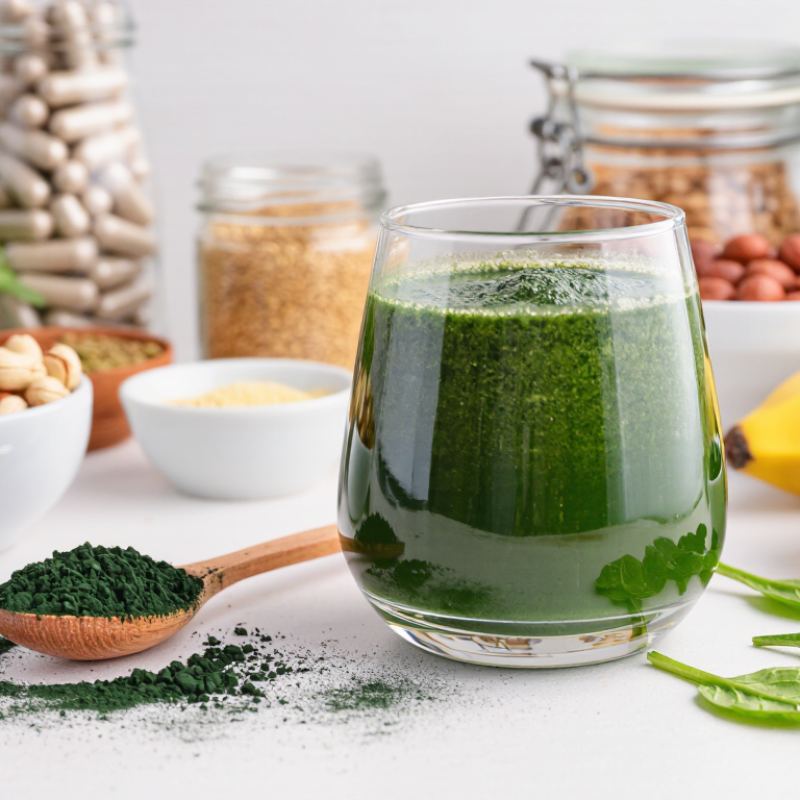
Spirulina powder begins with Arthrospira, a microscopic cyanobacterium often called blue-green algae. It is cultivated for food, then harvested, dried, and milled into a fine powder. The powder’s deep green-blue color comes partly from natural pigments, including phycocyanin. It has a mild, earthy taste that can stand out in a smoothie.
Arthrospira grows in water under managed conditions, where temperature, light, and water chemistry affect production. After harvesting, careful drying and handling help protect quality. Nutrient levels can vary with cultivation and processing, so broad claims about every powder deserve caution. That distinction matters. Spirulina is a food ingredient, not a shortcut to a balanced diet; its flavor and nutritional profile may not suit everyone. Reliable producers provide clear sourcing details and relevant quality testing, though labels alone cannot tell the whole story.
Tips: Start with a small amount and mix it into a strongly flavored food, such as fruit or yogurt. Check the ingredient list and storage directions. Keep the container sealed and dry. If the color looks unusual or the powder smells stale, pause before using it. Small details matter.
Spirulina powder’s protein figure is striking: USDA FoodData Central lists 57.5 g per 100 g of dried spirulina. This is a dry-weight comparison, not a typical serving. A 5 g portion provides about 2.9 g of protein. That distinction matters. A teaspoon may look vivid green, but it contributes only a modest amount of protein. The FAO’s 2008 technical review of spirulina production describes dried biomass as protein-rich, with reported levels commonly around 60–70% of dry weight. Differences between these figures can reflect cultivation conditions, processing, and analytical methods.
For shoppers comparing powders, the label and serving size deserve a close look. USDA’s number describes a food-composition entry; it does not guarantee that every batch has the same profile. Small details matter. Drying and growing conditions can affect composition, so manufacturers’ batch-specific laboratory results offer more useful guidance than a general headline figure. The FAO review and USDA data both support spirulina’s reputation as a concentrated protein source, but protein content alone does not tell the whole nutritional story. When calculating a recipe, use the product’s stated serving size rather than applying the per-100-gram figure directly.
USDA nutrient data lists 57.5 g of protein per 100 g of dried spirulina.
Protein, carbohydrate, and fat are shown in grams per 100 g. Values are rounded; carbohydrate includes dietary fiber.
Source: USDA FoodData Central, dried spirulina; nutrient values per 100 g.
Spirulina powder is popular in part because it can be produced in managed cultivation systems. Commercial farms often grow Arthrospira in alkaline water, where carefully controlled conditions support steady biomass production. Alkalinity can limit some unwanted organisms, but it does not prevent contamination by itself. Operators still monitor water quality, culture appearance, temperature, light, and nutrient levels. Small shifts matter. A change in color or unusual odor can prompt closer inspection before harvesting.
Tips: Keep simple daily records of pH, temperature, and culture appearance. Check meters regularly, and investigate sudden changes rather than relying on one reading.
Alkaline cultivation needs practical control, not just a high pH. Mixing helps circulate nutrients and exposes the culture to light, while excess heat or poor water quality can slow growth. Harvesting schedules also affect consistency; overly frequent collection may leave the culture struggling to recover. After harvesting, careful rinsing and drying help protect the powder’s quality. Results vary with local water, equipment, and operating skill, so one farm’s settings may not suit another. Even experienced growers make adjustments. That learning curve is part of commercial production.
Why Is Spirulina Powder in High Demand Worldwide?
Spirulina powder is valued for its deep blue-green color and distinctive taste. In foods, however, “spirulina powder” and “spirulina extract” are not automatically interchangeable terms. That distinction matters.
FDA regulation 21 CFR §73.530 covers spirulina extract as a color additive. It identifies the extract as derived from dried Arthrospira platensis biomass and permits its use for coloring foods under specified conditions. The regulation does not mean every whole-algae powder is covered by the same provision. Nor does it replace applicable food standards or labeling requirements. Check the ingredient’s identity and intended use carefully. That detail is easy to miss.
For product developers, the extract can provide blue-green color in items such as beverages, confectionery, and coatings, where a small amount may noticeably affect appearance. Color performance can vary with processing and storage, so testing in the finished food matters. A vivid sample in a clear cup may look different in an opaque or acidic product. Real formulations can be less predictable than expected. Manufacturers should review the current regulation and relevant requirements before using an ingredient as a color additive.
Spirulina powder attracts supplement makers because it offers protein and naturally occurring pigments in a compact ingredient. It appears in capsules, tablets, and drink mixes, where small portions are easy to add to a daily routine. Its earthy, sea-like taste can be divisive. Not everyone enjoys it. Nutrient levels vary with the species, growing conditions, and processing, so reliable product information matters.
Functional foods offer another route for spirulina. Manufacturers use it in smoothies, snack bars, and pasta to add color and a recognizable algae ingredient. A spoonful can turn a smoothie deep green, but flavor and texture still shape whether people will buy it again. More is not always better. Careful formulation helps prevent a grassy taste from overpowering other ingredients.
The vivid blue pigment phycocyanin, extracted from spirulina, is also sought after as a natural colorant. It can give drinks, sweets, and other foods a striking blue shade. Yet its color may be sensitive to heat, light, and acidity, which can complicate processing and storage. Natural does not mean effortless. Demand is growing, but the ingredient’s appeal depends on consistent quality and realistic expectations, not color alone.
| Demand Driver | Relevant Product Form | Factual Basis | Why It Supports Demand | Practical Considerations |
|---|---|---|---|---|
| Dietary supplements | Powders, tablets, capsules, and blended supplement products | Spirulina is a nutrient-dense cyanobacterium. Its dry matter is commonly reported to contain a high proportion of protein, although the amount varies with species and growing and processing conditions. | It is easy to incorporate into concentrated, shelf-stable formats and is often chosen by consumers seeking plant-based ingredients. | Composition varies by product. Supplements should be assessed for identity, quality, and possible contaminants; spirulina is not a substitute for a varied diet. |
| Plant-based nutrition | Blended powders, nutrition mixes, and plant-forward formulations | Spirulina provides protein and other nutrients, but its nutrient profile is not identical to that of conventional protein foods. | Interest in plant-derived ingredients encourages its use as one component in broader nutrition blends. | It is usually used as an ingredient rather than as the sole protein source. Flavor, color, and formulation compatibility can limit the amount used. |
| Functional foods and beverages | Smoothie mixes, nutrition bars, drink powders, and selected formulated foods | The powder disperses into many dry mixes and can contribute a distinctive green color and characteristic flavor. | Food makers can add a recognizable algae-derived ingredient to products marketed around plant-based or functional-food positioning. | Earthy or marine notes may affect taste acceptance. Heat, light, oxygen, and processing conditions can affect product quality and appearance. |
| Natural blue colorants | Phycocyanin-rich spirulina extract, rather than ordinary whole spirulina powder | Phycocyanin is the blue pigment associated with spirulina. Extracts are used to provide blue shades in certain foods where their use is permitted. | Demand for alternatives to some synthetic colors has encouraged interest in spirulina-derived blue ingredients. | Permitted uses differ by jurisdiction and food category. The pigment can be sensitive to heat, light, and acidic conditions, so formulation testing is important. |
| Vegan and vegetarian product development | Supplement blends and plant-based food formulations | Spirulina is produced from photosynthetic microorganisms and is used as a non-animal-derived ingredient. | It fits product concepts aimed at consumers seeking ingredients of non-animal origin. | Vegan positioning does not by itself establish suitability for every diet or consumer. Product labeling and ingredient handling should be checked. |
| Clean-label and ingredient diversification | Whole powder or standardized extract, depending on the intended function | Spirulina can serve as a recognizable food ingredient, while extracts can provide more targeted pigment functionality. | Manufacturers may use it to diversify ingredient sources and respond to interest in algae-based products. | “Natural” does not mean universally approved or automatically preferable. Regulations, specifications, and labeling requirements vary by market. |
Reading the table: These are established product applications and ingredient characteristics, not market-size estimates. Actual demand and permitted uses vary by country, product category, formulation, and applicable food regulations. Whole spirulina powder and phycocyanin-rich color extracts are distinct ingredient forms.
WhatsApp us